SOP Procedures
Upload the documents you already have and get back a clean, checklist-style procedure for every job in them.
Get SOP Procedures
Buy it and start straight away. You'll be taken to tools.minnsightai.com to check out and begin.
Buy · $199Purchases happen on tools.minnsightai.com, which is MinnSight.
A standard operating procedure is a written record of how a job gets done correctly, every time, by anyone on your crew.
Most small service companies do not have them. The knowledge lives in the owner's head and in the two techs who have been there longest. That works right up until one of them quits, gets hurt, or takes a vacation during your busiest month.
This page covers what SOPs are worth in a trade, what belongs in one, which ones to write first, and how North Star keeps them where your people will actually find them.
Why Written Procedures Matter More in a Trade Than in an Office
In an office, an undocumented process costs you an awkward week. In a service business, it costs you a callback, a warranty claim, an unhappy customer, and sometimes a safety incident.
Three things get expensive when procedures live only in people's heads.
Training gets slow. A new tech shadows for six weeks because there is nothing to hand them. Every hour of that shadowing is two people getting paid for one person's output.
Quality drifts. Two techs do the same tune-up differently. One of them skips a step that only matters twice a year, and you find out in July when the system fails on a 95 degree day.
Your best people get trapped. The tech who knows how to handle your oddest commercial account cannot take a week off without the account suffering. That is not loyalty, that is a single point of failure with a pulse.
Written procedures fix all three, and they are the single highest-return unglamorous thing an owner can do in a slow week.
What Actually Belongs In an SOP
A good procedure for a service business is short, specific, and written for the person doing the work, not for a binder on a shelf.
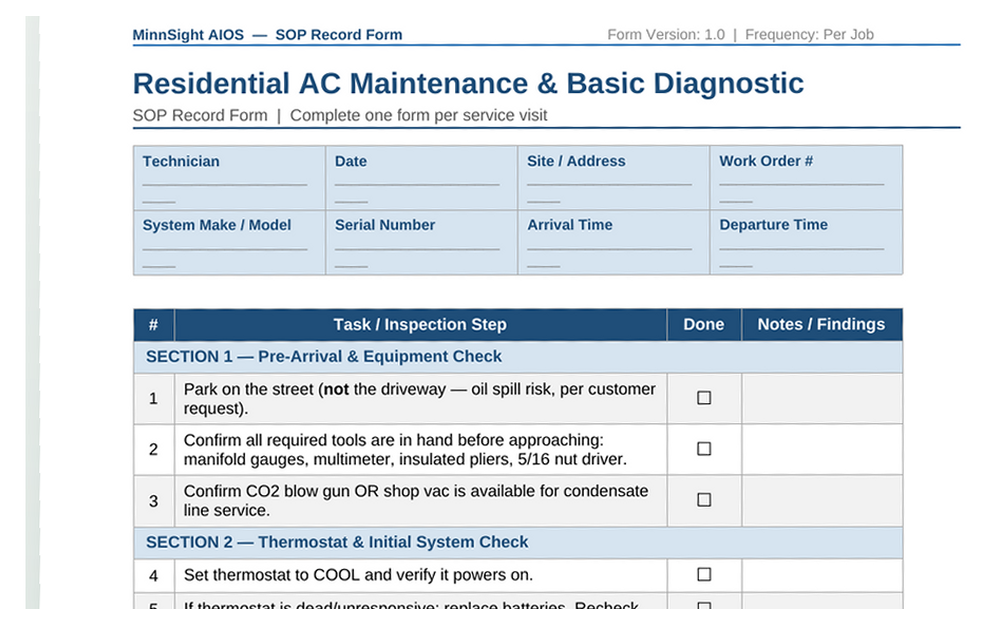
Each one should have a title that says exactly what it covers, a trigger that says when to use it, the tools and parts needed before you start, the steps in order, the checks that confirm it was done right, and what to do when it goes wrong.
Steps should be single actions. "Verify refrigerant charge against the manufacturer's subcooling target" is a step. "Service the unit" is not. If a step needs a judgment call, say what the tech should compare against and who to call when the answer is unclear.
Photos beat paragraphs. One picture of the correct valve position removes three sentences and every possible misreading of them.
Keep it to one page where you can. A four-page SOP does not get read on a job site.
The Ten Procedures Worth Writing First
Do not try to document everything. Write the ten that touch the most jobs or the most money.
Start with your highest-volume service, whatever that is for you: a maintenance visit, a standard cleaning route, a quarterly pest treatment, a pool opening. That one procedure covers the majority of your job count.
Then write your job close-out. What the tech does before leaving the site, what they photograph, what they write down, and how the job gets marked complete. This one is worth the most money, because incomplete close-outs are what turn finished work into uninvoiced work.
Then write your emergency call intake, your quoting process for the job type you quote most often, your new customer setup, your callback and warranty process, your truck stock and restock, your equipment and vehicle inspection, your invoicing and collections sequence, and your first-week onboarding for a new hire.
Ten procedures covers most of what a small shop does every day. You can write all ten in a slow week.
Where SOPs Live In North Star
An SOP nobody can find is a document that does not exist.
In a North Star build, procedures are attached to the work rather than filed in a folder. When a tech opens a job of a given type, the procedure for that job type is right there on the same screen. Steps can be turned into a checklist that gets ticked off, and the ticked checklist becomes part of the job record.
That does three useful things. Techs actually follow the steps, because the steps are in front of them. You get proof the work was done to standard, which matters when a customer disputes a job. And you can see which steps get skipped most often, which usually tells you the procedure is wrong rather than the tech.
New hires get handed a job and a procedure instead of a mentor and a hope.
Keeping Procedures From Going Stale
Most SOP efforts die the same way. Somebody writes twenty documents in a burst of enthusiasm, the process changes four months later, nobody updates the documents, and within a year the procedures are wrong and everyone has learned to ignore them.
Three habits prevent that.
Give every procedure one owner. Not a committee. One person whose name is on it.
Review on a schedule tied to your season, not to a calendar reminder nobody reads. Most trades have a natural slow period. That is when you review.
Let the field flag problems. If a tech follows a step and it is wrong, there should be a one-tap way to say so from the job. A procedure that gets corrected by the people using it stays alive. A procedure that can only be changed by the owner dies quietly.
If writing the first draft is the part that stops you, use the procedure author tool. It turns a recorded walkthrough or a rough written description into a structured SOP.
Get the Foundation In Place
Procedures work best sitting on top of a system that already tracks the jobs. Take the free audit and we will send back a written read on where your process gaps are costing you money. No call required.
Want to start writing tonight instead. Open the procedure author.
Common questions
Thirty to sixty minutes for a first draft if you know the process. Less if you record yourself doing it and let a tool structure it. The first one takes longest because you are deciding on a format.
A shared drive is fine for storing documents and useless for getting them used. The value comes from the procedure appearing at the moment of the work, which a folder cannot do. If your techs are not opening the folder, you have documents, not procedures.
Most resistance is to checklists that are too long or written by someone who has not done the job. Involve your best tech in writing the first three, keep them short, and cut any step that does not change the outcome. Resistance drops fast when the checklist is obviously accurate.
We build the system that holds them and we help structure the first set during a build. The content has to come from your shop, because the value is in your specific way of doing the work, not in a generic template.