Labor Rate Calculator
What an hour of your technician's time actually costs you, once you count the overhead, the unbillable hours, and the employer side of payroll that a plain hourly rate leaves out.
20 minutes · Excel
You pay $25.00/hr, but each billable hour actually costs 2.0× that once payroll, comp, benefits, overhead, and unbillable time are in the number.
- Annual base pay
- $52,000
- Employer burden + overhead
- $27,360
- Total annual cost
- $79,360
- Billable hours / year
- 1,560
Rule of thumb: if you bill below this number, that job loses money before you have paid for anything else. The downloadable spreadsheet does the same math for a whole crew and saves your inputs.
Want it to keep?
Enter your email and download the Excel to keep. Printable and offline, so you can save and reuse it.
We'll save your email to send the occasional update worth reading. No spam, unsubscribe any time.
Your tech makes $28 an hour. That number is almost useless for pricing.
By the time you add payroll taxes, workers comp, health insurance, the truck, the fuel, the tools, the phone, and the hours you pay for but cannot bill, that $28 hour costs you closer to $62. If you price off $28, or off $28 plus a guess, you are losing money on jobs you think are profitable.
What a loaded labor rate is
A loaded labor rate is the total cost to your business of one hour of billable field time.
It is not the wage. It is the wage plus every cost that exists because that person works for you, divided by the hours they actually bill customers.
Three phrases show up in searches and they mean slightly different things:
Labor burden is everything on top of the base wage that is tied to employing that person. Payroll taxes, workers comp, benefits, the truck, tools, the phone. Labor burden is usually quoted as a percentage of wages. A 45% burden means every dollar of wage costs you $1.45.
Overhead rate is your business costs that are not tied to any one tech. Rent, office salary, general liability insurance, marketing, accounting, software you use company-wide. Overhead gets spread across billable hours to produce a dollars-per-hour figure.
Fully loaded rate is wage plus burden plus overhead, all divided by billable hours. This is the floor. Charge below it and the job loses money no matter how it feels.
A one-person shop can stop at wage plus burden, because the owner is the overhead. A shop with an office person and a building needs all three.
The formula
Loaded labor rate = (Annual wages + Annual labor burden + Allocated overhead) ÷ Annual billable hours
Two halves. Get the top right and most people still get the bottom wrong.
Everything that belongs in the top half
Base wage. Hourly rate times paid hours. A full-time year is 2,080 hours. Include overtime at the rate you actually pay it.
FICA. Social Security and Medicare. The employer share is 7.65% of wages. Social Security stops at the annual wage base, which most field techs will not hit. Medicare has no cap.
FUTA. Federal unemployment. In most states the effective rate is 0.6% on the first $7,000 of each employee's wages, so about $42 per person per year.
SUTA. State unemployment. This one varies a lot by state and by your claims history. New employers usually land somewhere in the low single digits on a state wage base. Check your rate notice instead of guessing.
Workers compensation. Quoted per $100 of payroll. A roofing or HVAC field classification can run several dollars per $100. Clerical is a fraction of that. Use the actual class code rate on your policy, not a blended number.
Health insurance and benefits. Your monthly employer contribution times twelve. Add any retirement match, life insurance, or stipends.
PTO and holidays. Read this part carefully, because it is where double counting happens. If you pay a salary or you pay 2,080 hours a year, the cost of PTO is already inside the wage number. Do not add it again as a burden line. What PTO does is reduce the bottom half of the formula. Paid time off takes hours out of your billable pool. Handle it there.
Vehicle. Payment or lease, insurance, fuel, maintenance, tires, registration. If you own the truck outright, use depreciation or a realistic replacement reserve, because that truck is being consumed whether or not there is a payment.
Tools and equipment. Their tool allowance, replacements, meters, gauges, ladders, small equipment. Amortize the big items over their useful life rather than dropping a whole purchase into one year.
Phone and software. Their line, their tablet, their seat in whatever scheduling and invoicing system you run.
Training and licensing. Continuing education, certification renewals, license fees, safety training, ride-along time with a senior tech.
Uniforms and consumables. Shirts, boots, gloves, rags, shop supplies that never get billed.
The bottom half, which is where most owners go wrong
Here is the single biggest error in labor pricing: dividing total cost by 2,080.
You pay for 2,080 hours. Nobody bills 2,080 hours. Between vacation, holidays, sick days, shop time, drive time you do not charge for, warranty callbacks, truck stocking, monthly meetings, waiting on a supply house, and the mid-afternoon gap where the next call has not come in, a well-run field tech bills somewhere in the 1,300 to 1,500 range.
Call it utilization. If a tech bills 1,400 of 2,080 paid hours, utilization is 67%. That means every billable hour has to carry the cost of roughly half an hour of paid non-billable time.
Divide by paid hours and you underprice by about a third. That is the whole ballgame.
Be honest about this number. Pull last year's timesheets and last year's invoices and compare. The number you find will probably be lower than the number you assumed.
Worked example 1: single tech
One tech, paid $28 an hour, 2,080 paid hours.
Wages
| Line | Amount |
|---|---|
| Base wage, $28.00 × 2,080 | $58,240.00 |
Burden
| Line | Basis | Amount |
|---|---|---|
| FICA | 7.65% of $58,240 | $4,455.36 |
| FUTA | 0.6% of first $7,000 | $42.00 |
| SUTA | 3.0% of first $38,000 | $1,140.00 |
| Workers comp | $7.00 per $100 of payroll | $4,076.80 |
| Health insurance | $450/mo × 12 | $5,400.00 |
| Vehicle, all in | $800/mo × 12 | $9,600.00 |
| Tools and equipment | $1,800.00 | |
| Phone and software | $95/mo × 12 | $1,140.00 |
| Training and licensing | $900.00 | |
| Uniforms and consumables | $600.00 | |
| Total burden | $29,154.16 |
Burden as a percentage of wages: $29,154.16 ÷ $58,240 = 50.1%.
Total annual cost: $58,240.00 + $29,154.16 = $87,394.16
Billable hours. Two weeks vacation and six paid holidays remove 128 hours, leaving 1,952 available. Of those, this tech bills 1,400. That is 72% of available hours and 67% of paid hours.
Loaded labor rate: $87,394.16 ÷ 1,400 = $62.42 per billable hour
Compare that to the same cost spread over 2,080 paid hours, which gives $42.02. The gap between $42.02 and $62.42 is the non-billable time problem, and it is $20.40 an hour of pure invisible loss if you price off the wrong denominator.
Worked example 2: four techs and an office person
Now a shop with an owner who mostly runs the business, four field techs, one person in the office, and a building.
Direct labor wages
| Role | Rate | Annual at 2,080 |
|---|---|---|
| Lead tech | $34.00 | $70,720.00 |
| Tech 2 | $27.00 | $56,160.00 |
| Tech 3 | $24.00 | $49,920.00 |
| Apprentice | $19.00 | $39,520.00 |
| Total | $216,320.00 |
Direct labor burden
| Line | Amount |
|---|---|
| FICA, 7.65% | $16,548.48 |
| FUTA, $42 × 4 | $168.00 |
| SUTA, 3% of first $38,000 each | $4,560.00 |
| Workers comp, 7% of payroll | $15,142.40 |
| Health, $450/mo × 12 × 4 | $21,600.00 |
| Vehicles, 3 trucks × $9,600 | $28,800.00 |
| Tools, $1,800 × 4 | $7,200.00 |
| Phone and software, $1,140 × 4 | $4,560.00 |
| Training, $900 × 4 | $3,600.00 |
| Uniforms, $600 × 4 | $2,400.00 |
| Total burden | $104,578.88 |
Burden as a percentage of wages: 48.3%.
Total direct labor cost: $216,320.00 + $104,578.88 = $320,898.88
Overhead
| Line | Amount |
|---|---|
| Office person, $24/hr, wages + taxes + comp + health | $60,670.32 |
| Owner, $85,000 salary + taxes + health | $103,484.50 |
| Shop and office rent, $2,200/mo | $26,400.00 |
| General liability and umbrella | $6,500.00 |
| Company software | $6,000.00 |
| Marketing | $24,000.00 |
| Accounting and legal | $7,200.00 |
| Utilities and office supplies | $4,800.00 |
| Owner vehicle | $8,400.00 |
| Bad debt and miscellaneous | $5,000.00 |
| Total overhead | $252,454.82 |
Billable hours
| Role | Billable hours |
|---|---|
| Lead tech | 1,450 |
| Tech 2 | 1,400 |
| Tech 3 | 1,350 |
| Apprentice | 1,250 |
| Total | 5,450 |
The rates
Direct labor per billable hour: $320,898.88 ÷ 5,450 = $58.88 Overhead per billable hour: $252,454.82 ÷ 5,450 = $46.32 Fully loaded rate: $105.20 per billable hour
Check it the other way: $320,898.88 + $252,454.82 = $573,353.70, divided by 5,450 = $105.20. It ties.
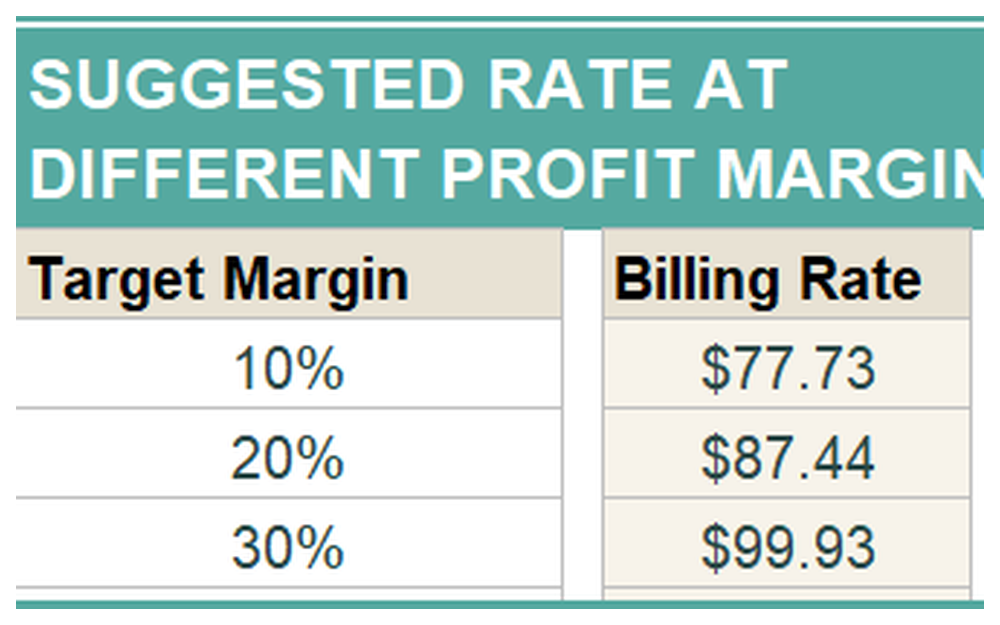
Turning cost into price. The loaded rate is a floor, not a price. Divide by one minus your target margin.
- 20% gross margin: $105.20 ÷ 0.80 = $131.50/hr
- 25% gross margin: $105.20 ÷ 0.75 = $140.27/hr
- 30% gross margin: $105.20 ÷ 0.70 = $150.29/hr
The next step is turning that number into job prices, one repair at a time.
Notice that the apprentice, at $19 an hour, is nowhere near cheap once you spread overhead across everyone. This is why blended shop rates beat per-person rates for most small operations. You are not selling a specific person's time, you are selling your company's capacity.
Common mistakes that make owners underprice
Dividing by 2,080. Covered above. The most expensive mistake on this page.
Leaving the owner out. If you turn wrenches thirty hours a week and pay yourself out of what is left, your labor is free on paper and your pricing is fiction. Put a market salary for your role in the model, then see if the business still works.
Forgetting the truck you already own. No payment does not mean no cost. That truck has a replacement date.
Using last year's workers comp rate. Rates move with your experience mod. So do health premiums.
Guessing at utilization. Pull the real numbers. Assumed utilization is always optimistic.
Ignoring drive time. In a dense route it might be 15 minutes between stops. In a rural service area it can be an hour each way, and that hour is paid.
Not counting warranty and callbacks. Free return trips are real hours that come straight out of billable capacity.
Treating overtime as the same cost. Time and a half on wages also increases the FICA, comp, and SUTA riding on those wages.
How often to recalculate
Rebuild it once a year, before you set next year's price book. Rebuild it sooner if any of these happen:
- You add or lose a field employee
- Your health insurance renews
- Your workers comp mod changes
- You add a truck
- Fuel moves substantially in either direction
- Utilization shifts by more than a few points
- You give raises
A quick quarterly sanity check takes fifteen minutes. Compare direct labor cost as a share of revenue against your target. If it drifted, find out why before it becomes a year of thin jobs.
Common questions
For a field service business, burden commonly lands between 40% and 60% of base wages once the truck, tools, and insurance are included. The exact number depends on your state's unemployment rate, your workers comp class code, and whether you pay for health insurance. There is no correct target. There is only your correct number.
No. The loaded rate is what an hour costs you. Your price is the loaded rate divided by one minus your target gross margin. If your loaded rate is $105 and you want 30% gross margin, you price at $150, not $137.
Split it by function. Hours you spend in the field are direct labor. Hours you spend estimating, dispatching, and running the business are overhead. If you are a solo operator, put the entire salary in direct labor and skip the overhead allocation, since there is nobody else to spread it across.
Their full annual cost goes in the numerator. Only the hours they actually bill go in the denominator. The shop half is absorbed automatically by the lower billable-hour count, which raises the loaded rate. That is correct behavior.
Start at 1,400 for a full-time field tech and treat that as provisional. Then track it for one quarter and replace the estimate with reality. If your real number comes in at 1,200, your loaded rate is roughly 17% higher than you thought, and so is the price you need to charge.